Why Mulch Basin Sizing Matters
The most common greywater system failure is pooling — water that sits on the surface instead of absorbing into the soil. The culprit is almost always an undersized basin. Properly sized mulch basins are the difference between a greywater system that works invisibly for years and one that creates a soggy, odorous nuisance.
This guide walks through the calculation process for determining basin dimensions based on your daily greywater volume and your specific soil's absorption rate.
The Basic Formula
Mulch basin sizing starts with one key variable: how much water per day, per zone. Divide your daily greywater volume by the number of irrigation zones to get the per-zone volume. Then apply a soil factor to get the required basin surface area.
The formula: Basin Area (sq ft) = Daily Volume Per Zone (gallons) × Soil Factor
Soil factors (square feet of basin surface area needed per gallon per day):
| Soil Type | Factor | Example: 20 gpd per zone |
|---|---|---|
| Sandy / gravelly | 0.30 | 6 sq ft basin |
| Sandy loam / loam | 0.50 | 10 sq ft basin |
| Clay loam | 0.80 | 16 sq ft basin |
| Clay / caliche | 1.20 | 24 sq ft basin |
Determining Depth
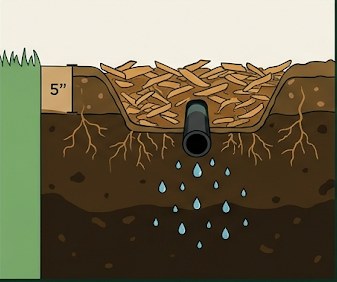
Basin depth depends on soil drainage characteristics. In sandy soils, deeper basins are fine — water moves downward readily. In clay soils, wider and shallower is better — you want more surface area for horizontal wicking rather than vertical percolation through a resistant layer.
Recommended depths by soil type:
- Sandy: 12–16 inches deep (can go deeper)
- Sandy loam: 10–14 inches deep
- Clay loam: 8–12 inches deep (widen before deepening)
- Clay / caliche: 6–10 inches deep (prioritize width)
In all cases, the top 3–5 inches should be wood chip mulch, with the water outlet buried beneath the mulch layer.
How to Test Your Soil Absorption Rate
Before sizing basins, test your actual soil. The percolation test:
- Dig a hole 12 inches deep and 6 inches wide at your planned basin location
- Fill the hole completely with water and let it drain (this pre-saturates the soil)
- Refill the hole completely and start timing
- Record how long it takes to drain completely
- Compare to the chart: under 30 min = sandy, 30–90 min = loam, 90–240 min = clay loam, over 4 hours = clay/caliche
If the hole still has water after 24 hours, your site has drainage problems that make greywater installation inadvisable without consulting a professional.
3-Way Brass Hose Splitter — Branch to Multiple Zones
You'll need one of these at every branch point where your main tubing run splits toward a separate mulch basin. Brass construction handles washing machine drain water temperature (up to 140°F), freeze-resistant for cold-climate states, and the ¾" GHT thread fits standard irrigation poly tubing adapters.
🛒 View on Amazon →As an Amazon Associate, GreywaterHub earns from qualifying purchases.
Multiple Zones: The Key to System Longevity
Distributing greywater across 3–8 zones rather than one large basin provides multiple benefits: each zone gets less water per laundry day, allowing the soil adequate recovery time between applications; plant diversity is easier to achieve; and if one zone develops drainage problems, the others continue working. Design for at least 3 zones even for small households.
Wood chip mulch is the preferred fill material — it decomposes slowly, keeps the basin loose and absorbent, and supports the soil biology that processes greywater residuals. Get free chips from ChipDrop.com (arborist drop-offs) or your city's yard waste composting program. Avoid rubber mulch (doesn't decompose and can leach chemicals) and fine bark (compacts too quickly).
Basin Shape Options
Basins don't have to be circular. Common shapes and their advantages:
- Circular: Easy to dig, uniform absorption. Good for single trees.
- Crescent/horseshoe: Wraps around the drip line of a tree, maximizing root zone contact without waterlogging the trunk base.
- Linear trench: Good for hedgerows or multiple shrubs in a line. Easy to route tubing along. Trench should be 12–18 inches wide and as long as needed.
- Contour basin: Follows the land's natural contours, preventing any runoff and maximizing infiltration on sloped ground. Used in permaculture-influenced designs.