Why Fruit Trees Are the Best Greywater Target
Fruit trees are ideal greywater recipients for several converging reasons. They have deep, extensive root systems that absorb large volumes of water efficiently. They're permanent plantings — once established, they benefit from consistent supplemental water for decades. They're high-value (a mature citrus or fig tree represents significant landscape investment). And unlike vegetable gardens, fruit trees can legally receive greywater in most states when water is applied correctly.
A single mature citrus tree in Arizona or Texas can use 15–30 gallons of water per week during summer. A household's laundry greywater can supply much of that need, reducing potable irrigation significantly.
The Legal Rule: Fruit Is OK, Edible Soil Contact Is Not
Every U.S. state with greywater regulations allows fruit tree irrigation — with one consistent condition: greywater must be applied below mulch or subsurface, and must not contact the edible portion of the tree. This means the fruit, the trunk, and low-hanging branches that might be touched by splashing water should remain completely dry.
In practice, this means:
- Water goes into a mulch basin at the tree's drip line (roughly under the outer edge of the canopy), not against the trunk
- The basin is filled with 4–6 inches of wood chip mulch covering the outlet
- No sprinkler or spray application — drip, bubbler, or subsurface discharge only
- The fruit itself never contacts the irrigation water or wet soil in the basin
Tree fruits that hang well above the ground — citrus, apples, pears, pomegranates, figs — present the lowest risk under this framework. Low-growing fruits like strawberries should not receive greywater under any state's rules.
Best Fruit Trees for Greywater Irrigation by Region
| Region | Best Fruit Trees | Notes |
|---|---|---|
| Desert Southwest (AZ, NM, southern CA) | Citrus (lemon, orange, grapefruit, lime), pomegranate, fig, jujube, date palm | Highly greywater-tolerant. Deep basins handle caliche. Citrus loves consistent moisture. |
| Texas / Southern Plains | Peach, plum, fig, persimmon, pomegranate, citrus (south TX) | Summer heat makes consistent moisture critical. Texas L2L is ideal for stone fruits. |
| California | Avocado, citrus, fig, olive, apple, pear, stone fruits | Avocado particularly responsive — they need consistent moisture and deep-rooted basins work well. |
| Pacific Northwest | Apple, pear, plum, cherry, quince | Use greywater in dry season (June–Oct) only. These trees need good drainage in wet months. |
| Mountain West (CO, UT, ID) | Apple, pear, peach, apricot, cherry | High-altitude stone fruits benefit from supplemental water during dry summers. |
| Southeast (FL, GA, NC) | Fig, persimmon, mayhaw, blueberry (caution), citrus (south FL) | Blueberries are salt-sensitive — use only verified low-sodium detergent. Florida water table concerns apply. |
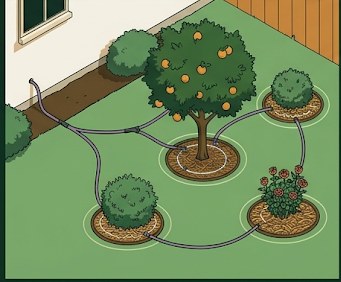
Basin Design for Fruit Trees
Fruit tree greywater basins differ from shrub basins in a few key ways:
Location: Drip Line, Not Trunk
Dig the basin at the tree's drip line — the circle directly under the outer edge of the canopy. This is where the feeder roots are most active. A basin dug against the trunk creates moisture problems at the root collar and doesn't reach the active root zone.
Shape: Crescent or Ring
For established trees, a crescent-shaped basin on the downhill side (if your yard has a slope) or a full ring basin around the drip line maximizes root contact. Many homeowners use two or three separate basins arranged around the drip line rather than one large ring.
Size: Larger Than Shrub Basins
A mature fruit tree can absorb significant volumes. Size your fruit tree basin to receive the full output of 2–3 laundry loads per application, with soil percolation as the limiting factor. A 15-square-foot basin in loam soil can absorb 30+ gallons per day without ponding.
Depth: Medium
10–14 inches is typical for most fruit tree basins. Fill the bottom 4–6 inches with coarse wood chips (which improve drainage and drainage), then top with finer mulch to the surface. The outlet tube should terminate 4–6 inches below the top of the mulch layer.
3-Way Brass Zone Splitter — ¾" GHT
Branch your greywater tubing to multiple fruit trees using this brass T-splitter. Full-flow, freeze-resistant, ¾" GHT — a reliable yard fitting that handles drain-water temperatures without degrading.
As an Amazon Associate, GreywaterHub earns from qualifying purchases.
Managing Sodium Accumulation Around Fruit Trees
Long-term greywater use — even with sodium-conscious detergents — can gradually raise sodium levels in the root zone. For fruit trees, which are sensitive to sodium-induced soil compaction, periodic flushing is important:
- Flush with potable water 2–4 times per year: Run potable water through the basin for 20–30 minutes to leach accumulated salts downward. Do this in spring and fall at minimum.
- Add gypsum annually: Calcium sulfate (gypsum) counteracts sodium dispersion in clay soils. Apply 1–2 cups per basin annually and water in. Available at garden centers for a few dollars.
- Monitor leaf health: Sodium stress in fruit trees shows as leaf tip and edge burn (marginal necrosis), starting with older leaves. If you see this pattern, increase flushing frequency and verify your detergent.
- Rotate basin locations: Every 3–5 years, consider moving basins to the other side of the drip line to give the previously irrigated soil a recovery period.
FAQ — Fruit Trees & Greywater
-
Yes — avocados are one of the best candidates for greywater irrigation in California and coastal climates. They need consistent moisture and benefit from the organic load in greywater. Use a crescent basin at the drip line, keep water away from the trunk (avocados are susceptible to root rot at the crown), and use low-sodium detergent — avocados are moderately sodium-sensitive. Flush the basin with potable water 3–4 times per year.
-
Yes — when greywater is applied correctly (below mulch, at the drip line, not contacting fruit or trunk), the fruit is safe to eat. Pathogens in laundry water do not travel upward through the tree's vascular system to the fruit. The key is that no water or wet soil contacts the rind of the fruit. Wash all fruit before eating, as you normally would. Extensive research in California's drought-water programs has confirmed this practice is safe under proper application conditions.
-
A mature citrus tree in the desert Southwest needs approximately 25–35 gallons per week during summer, tapering to 10–15 gallons per week in winter. A household running 5–6 loads of laundry per week with a front-loader generates about 85–100 gallons per week — enough for 2–4 mature citrus trees depending on season. In practice, most homeowners find their laundry greywater is sufficient for their primary fruit trees with some left for ornamentals.