Mistake #1: Undersized Mulch Basins
By far the most common failure. Homeowners dig small, decorative-looking basins and wonder why water pools. The math is simple: your soil has a fixed absorption rate (gallons per square foot per day), and your basin must provide enough surface area to absorb your daily volume before the next laundry cycle. Clay soil needs roughly 12 square feet of basin per 10 gallons per day. Sandy soil needs 3 square feet per 10 gallons per day.
Fix: Use the sizing calculator and do a percolation test before digging. When in doubt, build bigger — a basin that's twice as large as needed works fine; one that's half as large causes problems from day one.
Mistake #2: Skipping the Sewer Overflow Connection
Every greywater system requires a way to route water to the sewer when the landscape can't absorb it — during rainy seasons, after heavy irrigation, or on days you run many laundry loads. Homeowners who skip the overflow because "it seemed unnecessary" end up with a system that violates state law and causes ponding whenever the soil gets saturated.
Fix: The three-way diverter valve has two outlets by design. Connect one to your landscape tubing and one back to the standpipe. This is not optional in any state.
Mistake #3: Using the Wrong Detergent
Conventional detergents — Tide, Gain, Arm & Hammer with OxiClean — contain sodium lauryl sulfate, sodium carbonate, optical brighteners, and sometimes borax. Used daily for years, high-sodium detergents cause clay soil dispersion: the soil loses its structure and becomes compacted and impermeable. You'll see progressively worse ponding in basins that worked fine initially.
Fix: Switch to a greywater-safe detergent before redirecting water. Use our detergent checker to verify your current brand. Good choices: Oasis Laundry Liquid, ECOS Free & Clear, Charlie's Soap, Molly's Suds.
Mistake #4: Watering Too Close to the House Foundation
A frequent sight: mulch basins dug right against the exterior wall because the homeowner wanted to irrigate a narrow planting bed. Greywater applied near foundations can migrate toward the house, especially in clay soils. Over years, this causes moisture problems, staining, and in worst cases, foundation movement.
Fix: Maintain a minimum 2-foot setback from any building foundation. Most codes require at least this; many recommend 5 feet. Move basins to the drip line of plants rather than their base.
Mistake #5: Running Bleach Loads Through the System
Chlorine bleach kills the soil bacteria and fungi that make greywater irrigation beneficial and the soil productive. Homeowners who forget to switch the diverter before bleach loads gradually sterilize their irrigation zones. Plants in those zones start to decline after 6–12 months as the soil biology collapses.
Fix: Make a habit of checking diverter position before any load that uses bleach, whitener, or sanitizing additives. Post a reminder on or near the machine. Some homeowners put colored tape on the valve: red = sewer, green = greywater.
Mistake #6: Insufficient Mulch Depth
Outlets left under 1–2 inches of mulch dry out quickly, expose greywater to air (causing odor), and don't filter properly. State codes typically require 3–4 inches of mulch over all discharge points. Mulch also decomposes — basins that were properly mulched at installation may be bare within 18 months.
Fix: Use 4–6 inches of wood chip mulch (not fine bark or rubber). Add 2–3 inches of fresh mulch annually. ChipDrop.com connects you with arborists who drop loads free.
Mistake #7: Not Accounting for Seasonal Changes
A system sized for August irrigation demand in Arizona will flood basins in January when soil is saturated and plants don't need water. Homeowners who set-and-forget their diverter valve end up with ponding, odor complaints, and sometimes code violations during wet seasons.
Fix: Build the habit of flipping to sewer when landscape irrigation isn't needed — rainy periods, dormant season, after heavy rain. The diverter valve is there for exactly this. In the Pacific Northwest, plan to redirect to sewer November through April.
Mistake #8: Routing Water to Vegetable Gardens
This is a legal violation in every U.S. state with greywater rules, but homeowners do it anyway — particularly with laundry water that "looks clean." Greywater can carry pathogens (from skin, body oils, and laundry residues) that contaminate produce. The prohibition covers not just leafy greens but any edible crop including root vegetables.
Fix: Use greywater for ornamental plants, lawn, shrubs, and fruit trees (water applied under mulch, away from trunk and fruit). Use separate drip irrigation or potable water for vegetable beds.
Mistake #9: Ignoring Your HOA or Local Rules
Homeowners in HOA communities sometimes install greywater systems without reading their CC&Rs first. Even in states where greywater is protected by law from HOA prohibitions, HOAs can require notification before installation. Getting caught after-the-fact is more complicated than the five-minute step of checking first.
Fix: Read your CC&Rs, then send a brief written notification to your HOA board before installation. In most cases nothing comes of it. See our HOA guide for what HOAs can and can't restrict.
Mistake #10: Installing Where the Water Table Is Too High
Especially common in Florida, coastal areas, and low-lying properties in the Pacific Northwest. When the water table sits within 12–24 inches of the surface, even properly sized mulch basins won't drain correctly — the water has nowhere to go downward. This causes chronic ponding regardless of basin size.
Fix: Do a simple water table check: dig a 2-foot hole and observe whether water seeps in within a few hours. If it does, your site may not be suitable for subsurface greywater irrigation. In Florida specifically, get a county health department pre-application consultation before designing any system.
Mistake #11: Not Labeling Components
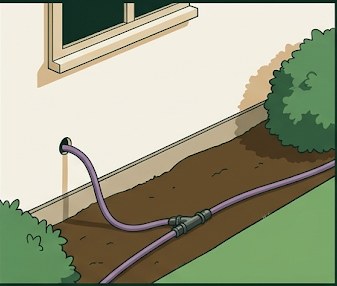
Unlabeled greywater systems create two problems: future occupants or plumbers don't know the system exists (creating health and accidental cross-connection risks), and in states requiring labeling (Texas, California, Arizona, and most others), it's a direct code violation that can come up during home sales.
Fix: Label everything. Purple pipe tape or weather-resistant "NON-POTABLE / GREYWATER" labels on every visible tubing section and the diverter valve. Create a one-page O&M document describing the system and keep it with your home records. Disclose it in any real estate transaction.